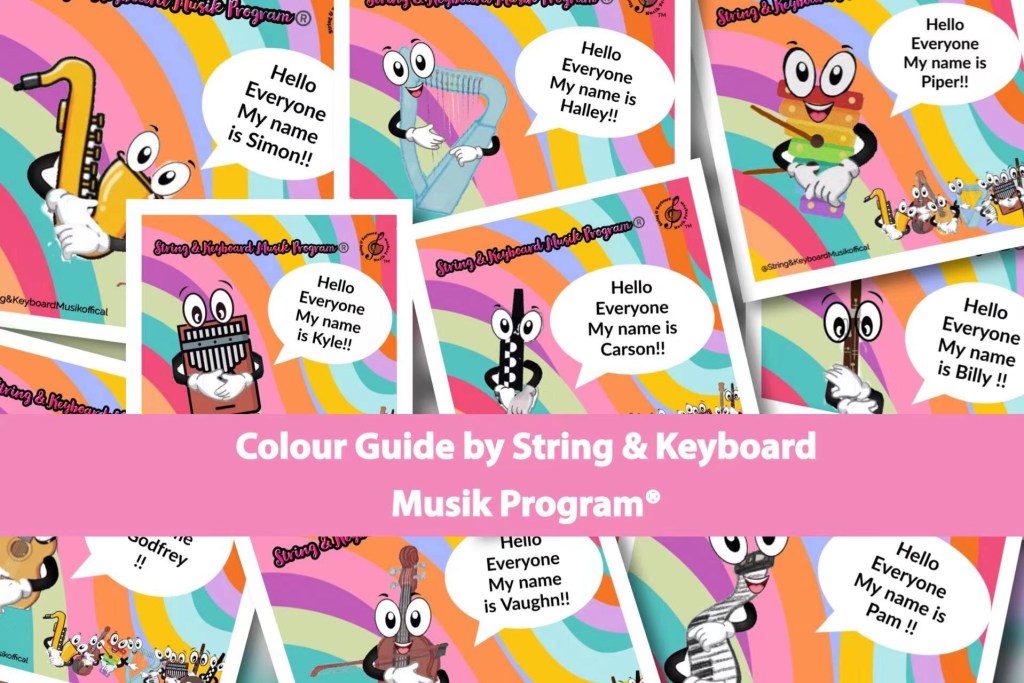
If you walk into an elementary classroom, you might notice that everything is colour-coded: signs and charts on the wall to labels on bins to pieces of tape marking certain spots on the floor.
This is because colours are easy for most young children to recognize and differentiate between.
But in music, our baseline is black and white, the colors of standard notation. When first introducing music-reading, it can be challenging for young students to recognize patterns and organize the content visually when everything is black and white.
For this reason, colour can be a helpful tool when teaching music literacy and developing music-reading skills. “When we use colour in a systematic way it can help students retain information better than just using black and white.”
For some, this might look like using coloured notation, where each note of the scale is represented by a different colour. This is often used in beginning handbell music.
But this isn’t the only way to teach with colour.
Today, we’re sharing four simple ways to use colour to teach music literacy. But first, let’s talk about some of the benefits of using colour as a teaching tool.
The Benefits of Using Colour
Colour provides a quick way of sorting and organizing visual elements, especially elements that are the same.
In an article on colour-coding your classroom, “Colour coding is especially beneficial for students who are non-readers or who are just learning to read. When colour is involved, grouping, material organization, and differentiation become much, much easier.”
When things are colour-coded, children can easily learn how to match things that are the same and identify things that are similar, but different. “Colour helps break concepts down and make them easier to digest.”
Think about what that might look like in music: note values, melodic patterns, rhythmic patterns, steps vs. skips, dynamic markings, high vs. low, white keys vs. black keys on the piano, vowel sounds (colours!), and much more.
And this isn’t just for children; think about how helpful it is to organize and sort things by colour for youth and adults, especially concepts that are new and unfamiliar.
How to Use Colour to Teach Music Literacy
Use Coloured Notation
If you used handbells or handchimes in your teaching, you’ve likely encountered coloured notation. This is a helpful way for young musicians and new readers to identify different pitches on the staff and correlating, bell or chime.
Recommend using coloured notation in this context, when each person is responsible for playing only 1-2 notes (and therefore, keeping track of only 1-2 colours).
Handbells come in rainbow colours: one colour for each note in the diatonic (or chromatic) scale.
Colour-Code Musical Form
Colour is a great way to mark musical form and indicate different sections of a piece, especially when listening to a new song or piece (without notation).
Using paper or card stock , choose a different color to represent each section of a piece (displayed at the front of the room, for all to see). If you’re working one-on-one or with a small group, consider using paint chips. Cut the paint chip cards apart ahead of time and make a set for each student.
Similar to what you mentioned above, consider cutting each one into a different shape, as well (e.g. triangle, square, circle).
Creative resource ideas:
• Paint chip cards — free from your local hardware store
• Coloured paper or card stock
• Coloured beat bags – this listing is for corn hole bean bags, available in 17 different colours.
Colour-Code Musical Patterns and Motives
Tis strategy all the time with my elementary piano students. Always identifying patterns that are the same and different in music, and often, then will have them draw boxes around measures that are the same using a coloured marker or highlighter. This is a quick and easy way to see how the music is organized, recognize phrase construction, and understand how the patterns fit together.
Similarly, you might choose to colour-code a short rhythmic pattern, even if the pitches are different OR a short melodic pattern, even if the rhythm is different.
Recommend choosing 1-2 colours for this type of project. Keep it simple and uncluttered so the important element (repeated patterns and motives) remains prominent.
Creative resource ideas:
•Coloured markers sets
Colour Notation
Creative resource ideas:
• Colour coded cards – a great introduction to bell- or chime-ringing use the chord approach.
• Colour coded fabric staff – includes 96 colored felt circles that match the colors of the Rhythm Band handbells. The Junior size (18″x14″) is small enough to hold or sit on a music stand; the larger size (28″x28″) has a rope at the top for easy hanging. It’s a great visual teaching aid for younger elementary children. Here is a quick video demonstration of how to use the color-coded fabric staff.
• Coloured coded marker set – great for creating your own chart-sized music or color-coding traditional black-and-white notation.
• Coloured code dots stickers- create your own chart-sized notation by using these stickers as the noteheads.
• Coloured code notation stickers great for creating individual music scores or as a fun composing activity for older elementary students.
• ChimeWorks Icon Chart – a suggested pairing of colored notation and shape-note notation.
Colour-Code Dynamic Markings
This is a fun way to observe dynamic markings in the score.
Students don’t often pay attention to dynamic markings in a new piece (and sometimes even in a piece we’ve been working on for a few weeks!).
Encourage students to play with dynamic expression from the beginning of learning a piece, rather than thinking of dynamics as something to add during the polishing phase. As such, sometimes we’ll take a minute early on in the process to study the score and colour-code the dynamics using something like this:
piano = blue
mezzo piano = purple
mezzo forte = pink
forte = orange
Here’s a little insight into the psychology of these colour choices:
Orange is a bright, vibrant colour, though not as dominant as red. When used to highlight something, orange may help learners retain information. Similarly, “blue ink, or blue highlighting can be used to help improve reading comprehension.”
 New Generation